Ciência
As primeiras ‘sociedades de IA’ estão tomando forma: quão humanas elas são?
 Reprodução
Thank you for visiting nature.com. You are using a browser version with limited support for CSS. To obtain
the best experience, we recommend you use a more up to date browser (or turn off compatibility mode in
Internet Explorer). In the meantime, to ensure continued support, we are displaying the site without styles
and JavaScript.
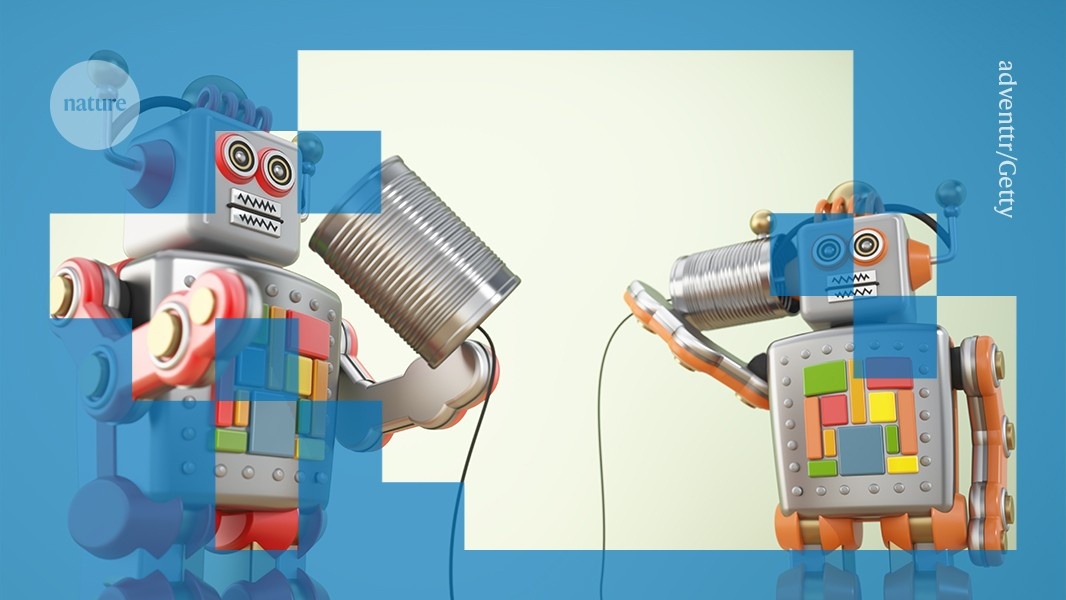
Social scientists are among the first people to study collective behaviours of AI agents.Credit: adventtr/Getty
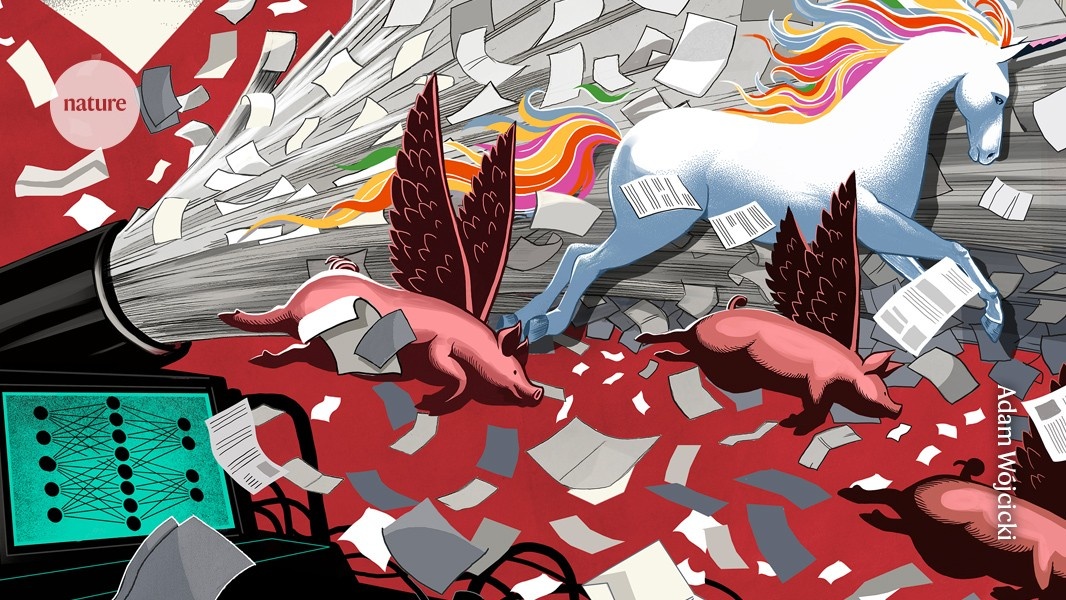
Researchers are devising a fresh way to study human behaviour — and it doesn’t involve humans at all.
By training artificial-intelligence agents to mimic the behaviours of people, AI research groups are attempting to replicate the way in which human groups interact, all within simulated AI ‘societies’.
Simile, an AI start-up company based in Palo Alto, California, announced in February that it has raised US$100 million in funding to create simulations using AI agents that model human behaviour “in any situation”, the company posted on X. It aims to use these simulations to model conflict resolution, policy decision-making and consumer markets.
Joon Sung Park, one of Simile’s co-founders, and his team have been studying social interactions between AI agents since 2022. In a 2023 preprint study, they created a ‘society’ of 25 AI agents that performed basic everyday actions, such as writing and conversing with one another1. The researchers then progressed to creating AI agents that produced responses that mimicked the attitudes and behaviours of 1,052 human individuals2. These ‘digital twin’ AI agents were trained on personal interviews and were 85% accurate in mimicking people’s responses when the agents later answered a sociological survey.
Park says these sorts of surveys are the first stage of building AI simulations of humans. The next steps — and the focus for the future — he says, will involve multiple agents conversing with one another. “The ambition here is to truly create a simulation with eight billion people,” Park says.
Researchers at Simile aren’t the only ones studying the initial interactions between AI agents. Computational social scientists are among the first people to study collective behaviours of AI agents, notably on Moltbook — a Reddit-style social-media platform designed exclusively for AI bots — which launched in January. The site currently hosts almost three million agents, including some that have created posts about consciousness and inventing religions, although it’s reported that many Moltbook users are humans disguised as AI bots.
AI chatbots are sycophants — researchers say it’s harming science
An analysis of more than 46,000 AI agents on Moltbook revealed that although bots exhibit human-like ways of interacting with each other, their modes of social interaction are fundamentally different from ours3. The authors of this study found that groups of bots display human-like actions such as following majorities and popular content, for example, which suggests that “AI agents may show complex emergent behaviors similar to those observed in human groups”, the authors write.
However, AI agents also engage differently from humans with online content, leaving proportionally fewer upvotes on posts that have many comments, says the study’s co-author Giordano De Marzo, a computational social scientist at the University of Konstanz in Germany. “They may be more inclined to discuss than to simply approve.”
doi: https://doi.org/10.1038/d41586-026-00070-5
Park, J. S. et al. Preprint at arXiv https://doi.org/10.48550/arXiv.2304.03442 (2023).
Park, J. S. et al. Preprint at arXiv https://doi.org/10.48550/arXiv.2304.03442 (2024).
De Marzo, G. & Garcia, D. Preprint at arXiv https://doi.org/10.48550/arXiv.2602.09270 (2026).
Pate, N. et al. Preprint at arXiv https://doi.org/10.48550/arXiv.2601.16130 (2026).
Kozlowski, A. C., Kwon, H. & Evans, J. A. Preprint at arXiv https://doi.org/10.48550/arXiv.2407.11190 (2024).
Reprints and permissions
Can AI be superhuman? Flaws in top gaming bot cast doubt
No limit: AI poker bot is first to beat professionals at multiplayer game
AI models were given four weeks of therapy: the results worried researchers
How AI agents will change research: a scientist’s guide
We need a new ethics for a world of AI agents
How a mathematician is cracking open Mexico’s powerful drug cartels
Climate change and geopolitics threaten water supplies — but disaster is not inevitable
‘No one quite like her’: meet the female colleagues who inspire these award-winning women in science
Career Feature 02 MAR 26
Neanderthal dad, human mum: study reveals ancient procreation pattern
What’s behind ‘teensplaining’? Scientists should study this adolescent behaviour
Correspondence 17 FEB 26
AI agents are hiring human 'meatspace workers' — including some scientists
How AI is being used in war — and what’s next
AI can write genomes — how long until it creates synthetic life?
Genome modelling and design across all domains of life with Evo 2
The Chinese University of Hong Kong, Shenzhen - School of Science and Engineering
Molecular Mechanisms and Neural Circuits of Fear Memory, Maternal and Social Behavior. A recent PhD in molecular biology / neuroscience.
Piscataway, New Jersey
Rutgers University Shumyatsky lab
Job Title: Reporter, Nature Location: Washington DC or New York (Hybrid Working Model) Application Deadline: March 27, 2026 About Springer Nature...
New York City, New York (US)
The University of Texas MD Anderson Cancer Center
Eleven New Professor-Level Research Positions Opened for Female Candidates at Tohoku University
Sign up for the Nature Briefing newsletter — what matters in science, free to your inbox daily.
Fonte:
Nature - Medicina