Ciência
Veja iguanas caindo do céu e corais de dentro para fora
 Reprodução
The month’s sharpest science shots, selected by Nature’s photo team.
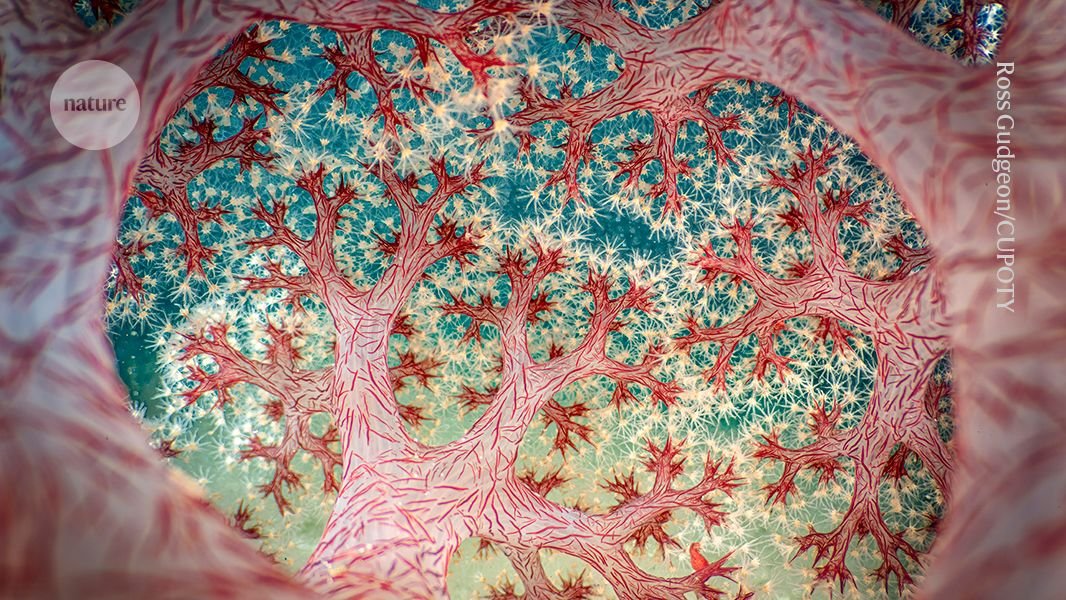
Coral life. This inside-out view of a cauliflower soft coral (Eunephthya thyrsoidea) in the Lembeh Strait in Indonesia, reveals its forest-like inner architecture, formed by tiny, rounded polyps that create the coral’s puffy texture. It won photographer Ross Gudgeon the grand Close-up Photographer of the Year contest. To get this unusual illustration-like shot, Gudgeon carefully threaded a special underwater probe lens between the coral’s branches. The red lines in the image show the coral’s sclerites — thin spiny pieces of calcium carbonate that support the animal’s soft body. The coral’s polyps have feathery tentacles that comb through water to trap plankton to feed on.
Cosmic anomalies. Researchers at the European Space Agency’s European Space Astronomy Centre in Madrid identified six previously unknown astrophysical objects. They used an artificial-intelligence tool to search nearly 100 million archival images captured by NASA’s Hubble Space Telescope. The tool is trained to recognize cosmic anomalies. The discoveries included a galaxy with a swirling core and two open lobes on its sides — a type of feature that was not known to astronomers. The images also feature galaxies in the process of merging, and a ring-shaped galaxy that formed when one galaxy crashed into the centre of another.
NASA, ESA, David O'Ryan (ESA), Pablo Gómez (ESA), Mahdi Zamani (ESA/Hubble)
Living on the edge. Twenty-five thousand residents of Niscemi, a town on the Italian island of Sicily, have been living precariously on the edge of a newly formed cliff. A 4-kilometre landslide tore away one side of the hilltop after Storm Harry brought severe weather in January. Local authorities evacuated more than 1,600 people. There have been no reports of deaths or injuries, but numerous buildings and vehicles have been destroyed.
Back from the brink. Under a microscope at Chester Zoo, UK, a greater Bermuda snail (Poecilozonites bermudensis) awaits its journey home. This button-sized species was once thought to have vanished from its native habitat in Bermuda, until a small surviving population was discovered in an alleyway in the capital, Hamilton, in 2014.
Conservation researchers at Chester Zoo have since bred the snails and released more than 100,000 of them into the wild. Established colonies are now confirmed at six sites in Bermuda. The zoo’s animal and plant director, Gerardo Garcia, described the efforts as a “once in a career” moment.
Darren Staples/AFP via Getty
Fake teeth. This grinning stone is a fossilized ancient organism and not a chance zoomorphic object. The teeth-like ‘beads’ are fossilized parts of the stem of a marine animal called a crinoid. Crinoids are part of the phylum Echinodermata, which includes sea urchins and sea cucumbers. Crinoids first appeared about 500 million years ago, and versions of them still exist today. Christine Clark was hunting for fossils on Holy Island of Lindisfarne, UK, when a tiny pebble seemed to be smiling at her. “It looked like someone’s fake teeth,” she said.
Iguana patrol. Florida’s wildlife agency has been asking the public to scoop up cold-stunned iguanas (Iguana iguana) in the state so they can be revived with the aid of warming mats. Reptiles such as iguanas are ectotherms, which depend on external sources of heat to regulate their body temperature. A cold front swept over the southeastern United States this month, causing the reptiles to become sluggish and even seem dead. Local residents reported iguanas dropping out of trees and falling on their heads. “It’s raining iguanas,” one Florida resident told Nature.
Sweet amnesia. A little taste of sugar can switch off memories that a fruit fly (Drosophila melanogaster) had made, but it does not wipe them out. This microscopic image of the insect’s brain shows some of the neurons involved in this process. In a series of experiments, researchers trained the flies to associate certain smells with a sugar reward. When the insects were given the treat on its own, they stopped approaching the smells that they had learnt to seek out. The researchers found neural traces of the smell memories in the fly’s brain cells, but activating those neurons could not influence the animal’s behaviour.
Warnecke et al., Current Biology (2026)
Underwater Moon. This photograph that captures the unique bond between a rare white humpback whale (Megaptera novaeangliae) and her mother won the grand prize in the World Nature Photographer of the Year. Photographer Jono Allen took the image in the South Pacific Ocean off of the islands of Vava’u in Tonga. The calf — named Mãhina, which means ‘moon’ in Tongan — was born without pigmentation, a 1-in-40,000 occurrence. “It was undoubtedly one of the most extraordinary days I have ever experienced in the ocean — and perhaps ever will,” said Allen.
Other winners include Alain Schroeder, who captured a 37-year-old female chimpanzee (Pan troglodytes) called Kayla being shaved for an ultrasound. Kayla lives in a chimpanzee sanctuary in Fort Pierce, Florida, together with more than 220 other rescue chimps.
Minghui Yuan also won a World Nature Photography Awards gold award for his shot of an unknown species of moss moth larva creating a protective nest on a newly grown leaf in the tropical rainforest of Xishuangbanna in China.
Vince Burton won silver for a worm-eye view of a great egret (Ardea alba) with its talons outstretched in Kraft Azalea Garden in Florida.
A tense encounter between predator and prey in a river in the Namib desert won silver for photographer Roman Balaz.
A hungry brown bear (Ursus arctos) charges headlong into a creek containing sockeye salmon (Oncorhynchus nerka) in Alaska's Katmai National Park. Photographer Charlie Wemyss-Dunn, who won gold for the image, perched on a cliff top to observe brown bears hunting the fish during their seasonal migration in August.
Fonte:
Nature-Notícias (Novo)