Ciência
Inteligência Artificial Escreve Genomas: O Próximo Passo para a Vida Sintética
 Reprodução
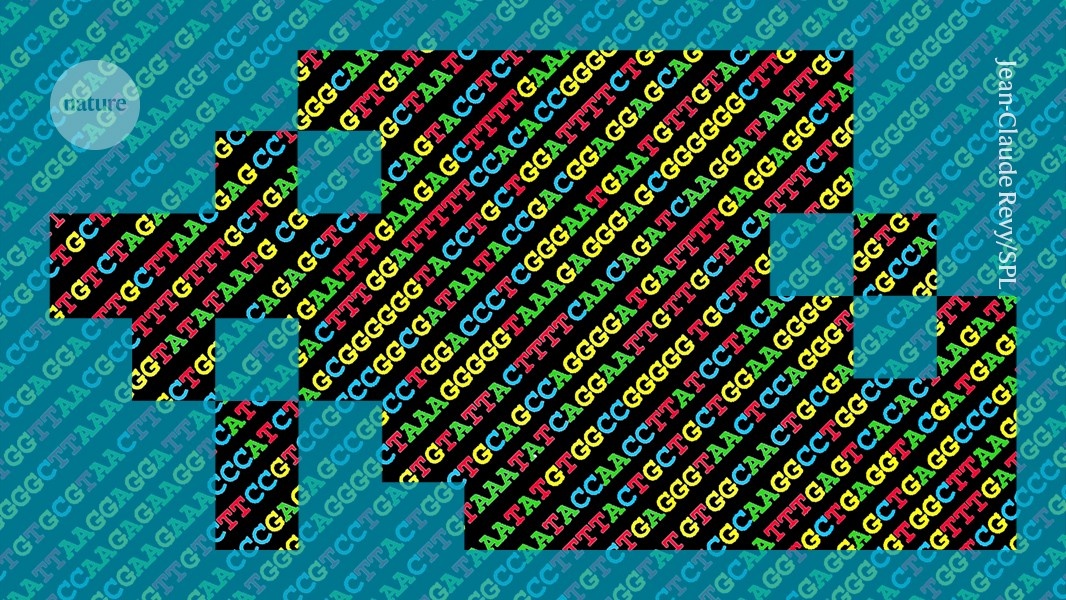
Evo 2 is an AI model designed to read, interpret and generate sequences of DNA, RNA and proteins.Credit: Jean-Claude Revy/SPL
In 2008, researchers reported the first ever synthetic genome of a living organism, which was produced by chemically synthesizing the 580,000-nucleotide genome of the bacterium Mycoplasma genitalium1 . Follow-up work ‘rebooted’ such genomes in cells, creating what scientists claimed to be the first example of synthetic life2.
Now, researchers have used artificial intelligence to design whole genome sequences, including one inspired by that of M. genitalium. The AI model is trained on trillions of DNA letters from organisms across the tree of life.
Although impressive, the genome designs — included in a Nature paper published on 4 March describing the Evo2 DNA language model used to create them3 — are just one step towards creating AI-generated microbial life, say other researchers.
“It’s cool, but it’s not there yet,” says Nico Claassens, a synthetic biologist at Wageningen University in the Netherlands. The need to synthesize and test AI-generated genomes at scale is one major hurdle. Another is designing genomes that can direct all the essential functions of even the simplest life forms, let alone those of more-complex cells.
Yet scientists who have been working for more than a decade to design genomes from scratch say that this once-audacious goal now seems tangible. “These AI models are the ‘ChatGPT moment’ for synthetic genomics,” says genome engineer Patrick Yizhi Cai at the University of Manchester, UK. “You can start writing things that never existed in nature.”
Previous efforts to write genomes have mostly amounted to tinkering, the equivalent of editing a chapter of an existing book or removing all the commas, says Cai, who is part of a nearly finished project to rewrite the genome of baker’s yeast (Saccharomyces cerevisiae)4. Another effort recoded the genome of the bacterium Escherichia coli at nearly 20,000 locations, dispensing with 3 of the 64 ‘codons’ that specify instructions for proteins5.
DNA language models such as Evo2 raise the possibility of making synthetic life forms that differ more substantially from existing life. In 2025, Brian Hie, a computational biologist at the Arc Institute in Palo Alto, California, and his colleagues used Evo models to write genomes of bacteria-infecting viruses called phages6. When the researchers inserted the instructions into E. coli cells, 16 of 285 designs produced functional viruses capable of killing bacteria.
Biggest-ever AI biology model writes DNA on demand
But the phage genomes were several thousand DNA letters long, encoding a handful of genes. This is vastly smaller and less complex than even small bacterial genomes, and most scientists see viruses as genetic parasites that lack many hallmarks of life.
In the latest Evo2 paper, a team led by Hie and Arc Institute bioengineer Patrick Hsu used the model to create the M. genitalium-inspired genome, as well as those of human mitochondria and a yeast chromosome.
Computer predictions suggested that nearly 70% of the genes in the M. genitalium-inspired sequences looked realistic. But if even one essential gene is missing or poorly modelled, the genome wouldn’t work inside a cell, says Claassens. “You cannot design life 70%. You can do that on a computer, but it will not be functional.”
Even if all essential genes were included, how those genes are ordered could also make or break a design, says Maciej Wiatrak, a machine-learning scientist at the University of Cambridge, UK, who has developed another AI tool, Bacformer, capable of generating bacterial genomes7. “Evaluating whether your genome looks correct and works correctly are two different beasts.”
doi: https://doi.org/10.1038/d41586-026-00681-y
Gibson, D. G. et al. Science 319, 1215–1220 (2008).
Article
PubMed
Google Scholar
Gibson, D.G. et al. Science 329, 52–56 (2010).
Brixi, G. et al. Nature https://doi.org/10.1038/s41586-026-10176-5 (2026).
Article
Google Scholar
Goold, H. D. et al. Nature Commun. 16, 841 (2025).
Fredens, J. et al. Nature 569, 514–518 (2019).
King, S. H. et al. Preprint at bioRxiv https://doi.org/10.1101/2025.09.12.675911 (2025).
Wiatrak, M. et al. Preprint at bioRxiv https://doi.org/10.1101/2025.07.20.665723 (2025).
Tzanakakis, A., Mouratidis, I. & Georgakopoulos-Soares, I. Preprint at bioRxiv https://doi.org/10.64898/2026.01.17.700093 (2026).
Reprints and permissions
World’s first AI-designed viruses a step towards AI-generated life
AlphaFold is running out of data — so drug firms are building their own version
The huge protein database that spawned AlphaFold and biology’s AI revolution
AlphaFold is five years old — these charts show how it revolutionized science
‘Set it and forget it’: automated lab uses AI and robotics to improve proteins
Collective intelligence for AI-assisted chemical synthesis
The asymmetric synthesis of an acyclic N-stereogenic amine
Direct deaminative functionalization with N-nitroamines
Identical twins on trial: can DNA testing tell them apart?
How these koalas bounced back from the brink of extinction
Genome modelling and design across all domains of life with Evo 2
The first ‘AI societies’ are taking shape: how human-like are they?
How AI is being used in war — and what’s next
Molecular Mechanisms and Neural Circuits of Fear Memory, Maternal and Social Behavior. A recent PhD in molecular biology / neuroscience.
Piscataway, New Jersey
Rutgers University Shumyatsky lab
Job Title: Reporter, Nature Location: Washington DC or New York (Hybrid Working Model) Application Deadline: March 27, 2026 About Springer Nature...
New York City, New York (US)
The University of Texas MD Anderson Cancer Center
Job Title: Deputy Editor, Communications Medicine Location: Shanghai, Beijing, Hybrid Working Model Application Deadline: Mar 26th, 2026 Ab...
Shanghai, Beijing, Hybrid Working Model
Seeking exceptional Senior/Junior PIs, Postdocs, and Core Specialists globally year-round
Hangzhou Institute of Medicine Chinese Academy of Sciences (HIMCAS)
Sign up for the Nature Briefing newsletter — what matters in science, free to your inbox daily.
Thank you for visiting nature.com. You are using a browser version with limited support for CSS. To obtain
the best experience, we recommend you use a more up to date browser (or turn off compatibility mode in
Internet Explorer). In the meantime, to ensure continued support, we are displaying the site without styles
and JavaScript.
Fonte:
Nature-Notícias (Novo)